The Bus Took Us (To War)

Note the destination sign on the left at the Lockheed plant. 1943
Fridays here are dedicated to Los Angeles transit, and its connection to Highland Park. Although the focus is on how Trolleys and Trains took us there, today’s post an exception has to be made for the above photo from The Metro Library and Archive’s Flickr photostream. The year was 1943, the nation was at war, and Highland Parkers were called on for the war effort. Every day, hundreds of workers would travel from Figueroa Street & Avenue 50 to the Lockheed factory in Burbank to build P-38 Lightning fighter planes for the war. And every day a bus like the ones above would take them home.
Poetry In The Windows VI

Poem, “All My Poems Hate Me” by Charles Hood in the window of Delicia Bakery on Figueroa.
For 25 years, The Arroyo Arts Collective has been keeping the great flame of arts heritage alive in Highland Park. Besides their annual Discovery Tour, puppet productions, and temporary art installations, their great contribution to culture in Northeast Los Angeles has been the written word in the form of poetry. For the sixth time in 19 years, The Arroyo Arts Collective has mounted the wonderful public exhibition, Poetry In The Windows.
Poetry in The Windows is just that: Poetry in the windows! Poems placed in the business windows along Figueroa Street from Avenue 55 to Avenue 60. There were over two dozen Highland Park businesses participated in this edition of the PITW. Places as diverse as Chez Antonine, LAs Cazuelas, Twinkletoes Dance Studio, La Plalapa, Future Studio, Marcello’s Hair Salon, Bird Man Pet Shop, Slow Culture Gallery and Bearded Beagle Vintage put up the poems from contemporary poets in their windows.
On Saturday, the 19th Day of the National Poetry Month of April, Arroyo Arts Collective held a special Poetry Walk that set off from the Highland Park Ebell Club over to Figueroa Street to see the poems and hear the poets read their works. This was made extra-special by the presence of Poet and Highland Park daughter, Suzanne Lummis who made a special effort to have each business owner step outside and hear the poets read their poems to them. The poems are scheduled to be up until May 31, but this being Highland Park, you will likely see them well into the summer and beyond.


Historic Highland Park Neighborhood Council Elections 2014

The Change-Makers of Highland Park.
On Wednesday, April 16th, the 777-person capacity Tyler Auditorium at Luther Burbank Middle School hosted a two-hour Historic Highland Park Neighborhood Council candidate forum for 18 candidates and 15 audience members. Not quite the crowd as organizers had hoped for. Maybe it was because last week was Spring Break for most Highland Park residents, maybe it was $4 movie night at the Highland Theatre, or maybe voters didn’t see the dozen or so banners all around Highland Park telling them about tonight’s event. Whatever the case, what is important here is that Eighteen candidates showed-up to enlighten us on why we should vote for them, and four others who couldn’t attend, took the time to submit statements for the forum.


Candidates not present but who submitted statements are: Boo Caban, who wants to fight to get the same level of service more affluent neighborhoods get. (That’s what I’m talking about!) Javier Cabral, a journalist who recently moved to Highland Park wants to keep the neighborhood in balance. Amirah Noaman, program director for Eagle Rock Yacht Club has the distinction of being the only candidate from Highland Park (New Jersey)! She wants to use her skills in fundraising and organizing to help the council. HHPNC member, Johanna Sanchez is a lawyer who wants to continue to focus on land use and outreach for the council. No statement was submitted by Gabriel Lozano, David Andrés Kietzman, Mauro A Garcia, and Steve Crouch who was absent due to a concert he wanted to take his 92-year-old mother to. Not pictured is current HHPNC Treasurer, and future HHPNC Treasure Joan Potter, who is running unopposed. She demonstrated her economy prowess by not bothering to make a statement. Because, why bother?
The empty auditorium inspired candidates to talk about how they would successfully outreach to Highland Park. Community events, consistency, promotions, networking, and partnerships were proposed in various forms as means to get people involved. The fact that so many candidates showed up to throw their hats into the ring is an encouraging sign. As the saying goes: Showing up is half the battle.
2014 Historic Highland Park Neighborhood Council Election
Saturday, April 26, 2014. 9AM-3PM
Highland Park Senior Center
6152 N. Figueroa Street
Highland Park, CA 90042
Bring identification / documentation showing that you are a Resident, Homeowner, Property Owner, Business Owner, Horse Owner, etc. Details HERE. Voters must be at least age 16 to vote.
Update 4.30.14:
And the winners are…
President:
MONICA ALCARAZ
First Vice-President:
AARON SALCIDO
Second Vice-President:
DIEO R. SILVA
Secretary:
JOHANNA A SANCHEZ
Treasurer:
JOAN POTTER
At-large Directors:
GRAEME FLEGENHEIMER
MAURO A GARCIA
LIZ AMSDEN
STANLEY W. MOORE
JOHANNA A SANCHEZ
DIEGO R. SILVA
HARVEY SLATER
FERNANDO VILLA
AMIRAH NOAMAN
BOO CABAN
JAVIER CABRAL
JESSICA CEBALLOS
MIGUEL RAMOS
SUSANNE HUERTA
See the Election Day tally here.
All challenges from sore losers aside, swearing-in should happen in June. Congratulations and Best of Luck to all the winners!
.
April Foolin In HP

Huntington Park 90255
Oh the fun of Twitter! Oh the fun of April Fools’ Day!
Inspired by a hashtag, and the annoyance of successive newcomers to Highland Park trying to be cool by abbreviating our name to “HP,” (Anyone who’s lived here long enough, knows we abbreviate it as “HLP.”) this blogger headed south via the Metro 251 Bus from Figueroa and Avenue 26 to the heart of the real HP: Huntington Park to fool around on April Fool’s Day. The entire day was spent tweeting as HP90255 instead of the usual HLP90042. It was fun. It was funny. But also an opportunity to compare and contrast our Highland Park with their Huntington Park.
Huntington Park is a nice place. Like Highland Park, it was developed as a Streetcar Suburb. (So much a streetcar suburb that the founding fathers named it after Pacific Electric streetcar magnate, Henry E. Huntington just to entice him into building a route to their town.) Like Highland Park, Huntington Park has many pre-1950 single-family homes (with more than one family) and many apartment buildings surrounding central commercial streets. Their Pacific Boulevard, is much like our Figueroa Street, with many of the same department stores and other commercial buildings built in the early 20th Century. 90255 is slightly smaller than 90042, and slightly denser in population with 58,000 residents. The median income for Huntington Park is $39,185, compared to Highland Park’s median income of $45,478. Education-wise, only 4.7% of the residents have 4-year degrees, compared to Highland Park’s 14.3%. Huntington Park is less ethnically diverse than Highland Park. With 95.1% of the population being Latino, it is the largest ethnically Latino city in Los Angeles County. (Latinos make up 72% of Highland Park’s population.)
The two things that are most striking about Huntington Park, compared to Highland Park is how flat the place is. That is, there are no hills! A type of terrain completely foreign to Highland Parkers. The other big difference is how surprisingly clean and well-maintained this city is. Even though Huntington Park is imbedded within an industrial area, it is by-and-large a well-kept town, lacking litter and the something-dumped-on-every-block mentality that plagues Highland Park. Also, where’s the graffiti? Sure, it exists, but unlike Highland Park where you can’t look at a pole, sign, broken sidewalk, garage, wall, street, curb, dumpster, abandoned couch, utility box, fence, tree, window, door, or mural without seeing someone’s name tagged on it, Huntington Park is practically blank. (True story: Saw a teenager in the park pick up a pen from the floor, walk over to a trash can, and instead of writing on it, he threw it away!) The city parks are all green and free of gophers. The playgrounds are un-vandalized. There are rose gardens all over the place. There aren’t shopping cart armies roaming the streets scavenging the trash cans, or stray dogs in the streets. Huntington Park is CLEAN.
Sure there were other differences, such as HP lacking the artistic influence that Highland Park has; didn’t see any murals, art galleries or art spaces. Historic Preservation is not much of a driving force as it is here in Highland Park. There are no bike lanes or bike routes, and the city has only one sidewalk-installed bike rack (recently placed at their first parklet on Pacific Blvd). Aside from being under the LAX flight path, there is a quietness to HP that escapes Highland Park with the sound of the frequent LAFD and LAPD sirens combined with airship manhunts that lock-down neighborhoods for hours on end. Also, Huntington Park is devoid of house flippers. Unlike Highland Park, the city is completely free of horizontal slat fences.
Quality-of-life wise, Huntington Parkers have it made. HP shows us that smaller is better and more effective. No, HP is probably not going to be mentioned in Condé Nast any time soon, but they should be proud, theirs is a fine working-class city without many of the problems that grip comparable City of Los Angeles’ neighborhoods such as our HLP.


Walking Eagle Rock

1948: The last time Colorado Boulevard was reconfigured. The year that the 5 Line streetcar tracks were ripped-out and six multipurpose traffic lanes were installed.
On Sunday, March 22, pedestrian advocacy group, Los Angeles Walks hosted an ambassador-led walking tour of the newly traffic-calmed Colorado Boulevard from Swörk at Eagle Rock Boulevard, up to Eagle Rock’s Eagle Rock at Richard Alatorre Park. The walk was led by Glassell Parker and Occidental College’s Urban and Environmental Policy Institute professor, Mark Vallianatos, and Eagle Rock Neighborhood Council member, Ashley Atkinson. The walk served as a fundraiser for the Los Angeles Walks organization and as way to highlight the pedestrian improvements to Colorado Boulevard in the past year.
There were kids in strollers, dogs on leashes, a family on razor scooters, neighborhood council members, urban planners, and walking enthusiasts from as far as Santa Monica. We walked up Colorado, stopping to note the history of the boulevard, the history of LA City planning and building codes, as well as the recent improvements like the new crosswalks, and the road diet that replaced one multimodal travel lane with a buffered bike lane.
As we walked one fact stood out more than any other: Colorado Boulevard is LOUD. Very loud. So much so, that even though the guides used a bullhorn, much of the tour guiding was unheard due to roar of auto traffic racing up and down the boulevard. This points to another issue that has become more apparent recently: The desirability of Colorado Boulevard to small businesses. More new businesses are choosing the narrow street of Highland Park’s York Boulevard over Eagle Rock’s broad and heavier auto trafficked streets. Because of the lack of galleries, the monthly 2nd Saturday NELA Art Night has almost completely abandoned Eagle Rock for Highland Park. Just this month, Chicago import, Permanent Records moved their store from Colorado Boulevard to York Boulevard, in large part because York Boulevard feels like a village, whereas Colorado Boulevard feels and looks like a highway.
The highway problem on Colorado Boulevard is exactly what residents and business owners have been trying to address for decades. Take Back The Boulevard, The Eagle Rock Association, the Eagle Rock Neighborhood Council, and Council District 14 Council Member, Jose Huizar, as well as eight other local organizations are all united with the effort to revitalize Colorado Boulevard by implementing Complete Streets enhancements. The only real voice of dissent has been Tom Topping, publisher of the Boulevard Sentinel, who whipped locals into a frenzy last year by essentially proclaiming in his “Newspaper” that the sky was going to fall if bike lanes were installed on Colorado Boulevard. The sky is still there. (Fun Fact: Topping started his “Newspaper” 17 years ago as a means to protect Colorado Boulevard’s auto-centricity.)
And yet, this is as far as Colorado Blvd has come. The Colorado Vision Plan, speaks of a better future where there will be bulb-outs, sidewalk extensions, landscaping, shade trees, parklets, transit shelters, benches, and possible cycle tracks. But this is Los Angeles, where anything that doesn’t have well-monied lobbyist pushing for it, it doesn’t get done. To CM Huizar’s credit, his CD14 is by far, the most progressive when it comes to Complete Streets.
Meanwhile, just eight miles away in sleepy Temple City, they are completing a $20.7-million project that re-invents Rosemead Boulevard (Another street that was originally a streetcar line) as a pedestrian and bike-friendly boulevard instead of a minor highway cut-through between the 10 and 210 Freeways. The same thing can be seen throughout California. The military beach town of Oceanside is in middle of redeveloping their downtown with Complete Streets. The first in L.A. County to truly embrace Complete Streets was Long Beach back in 2011. The People’s Republic of Santa Monica continues to make strides, regardless of the pressure from Westside automobile commuters. The list continues to grow where cities are parking cars, and putting people first again. Eagle Rock and Highland Park both have these great pedestrian-centric walkable neighborhoods developed a hundred years ago as streetcar suburbs. We just have to build upon the bones that survived, and get out of our cars and back on our feet.


Playing In The Sandbox

Adults and kids alike get to play in the sandbox of park design.
Tonight was the third York Park Planning Workshop for the vacant gas station lot at Avenue 50 and York Blvd. About thirty Highland Parkers attended the two-hour event at Buchanan Elementary School, facilitated by the office of Council District 14 Council Member José Huizar. Design options that the City could implement were presented followed by the community getting to play in the design sandbox by drawing on copies of the general plan. Over the past two planning workshops, the main features and shape of the quarter-acre park have been narrowed down, tonight was about refining those decisions and coming up with the fine details like color schemes, landscaping, furniture, and equipment.

Highland Parkers, ready to plan.
At this point, part of the City requirements is that the property be fenced. The size and style of that fencing has yet to be determined. The prevailing consensus among the evening’s participants is that they would prefer as low and as least obstructive fence as possible. An interesting component of this new park is that it will have a surveillance camera that is not monitored, but only used for recording.
The participants were very keen about making sure this park was an attractive park that fit well into the neighborhood. The use of native plants, arroyo stone, and earth tones were part of the key features being stressed by the community. Another important feature the community members are requesting is a mural wall, a curated public art gallery, and mosaic elements throughout the park that reflect the artistic heritage of the neighborhood. To that end, a petition is being circulated to name the park in honor of Arroyo Arts Collective co-founder, Hendrik Stooker who died last year. (Don’t get me wrong, Stooker was a significant community member, but do we ALWAYS have to name a park for someone???)

Design #13, the best of everything.
If all goes as theoretically planned, we will have the most pimped-out city pocket park in Los Angeles. Art, mini library, play equipment, chess tables, lawn area, an amphitheater, a stage, exercise equipment, water play area, picnic tables, benches, a public restroom, shade structure, native trees and plantings are all possible options on the table at this point. Not everything will fit, but most of it will be part of the final plan that will be voted on by the community when the final design presentation is held on Saturday, December 7th at 10AM in the park site at 4956 York Boulevard. The public will have the day to stop in and vote their choice for the winning design. The park is expected to be completed by this time next year.


Highland Park’s New Friend

What a friend we have in donuts…
Highland Park has long been considered a special place, but now it is a very special place because right now it is the only place in the world with a Donut Friend.
Northeast Los Angeles is no stranger to the Donut Arts. This after all, is where the most powerful donut empire in the Western United States began with Yum Yum Donuts in 1971 on the corner of Figueroa and Avenue 26. And while 90042 may still be home to the best glazed donut in Los Angeles at Monterey Donuts in Hermon, Donut Friend has upped the game considerably. Over in the East San Gabriel Valley, Glendora’s Donut Man has been blowing people’s minds for decades by putting fresh fruit on their donuts. Which is awesome. But Donut Friend has electrified the acoustic guitar of pastries, their donuts goes to eleven.
Jam, cheese, bacon, bananas, basil, nutella, mint, fudge, olive oil, jalapenos, sriracha, ice cream, chocolate mousse, candied oranges, caramel, and sugar glaze are among just a few choices you can put on you’re basic $2 vegan traditional or cake donut. (For $2.50, you can get a stupid-healthy vegan baked donut.) The D.I.Y. donut option is a fun way to show yourself and your friends (who are not donuts) what an awesome or awful pastry chef you could be. But don’t let that stress you out, there is a list of Donut Friend Compilations where you can show off your music prowess by getting the band and song references that the donuts are named after. (Fudgegazi = Fugazi, Lemon Weapon = Legal Weapon, GG Almond = GG Allin, Caramel on Parade = Christ on Parade, Dag Nutty = Dag Nasty, Jets to Basil = Jets to Brazil, Rights of Sprinkles = Rights of Spring, etc…) The donuts are good. Really good. I find myself avoiding York Blvd all together, just to keep from eating too many of their donuts. To go with these spectacular donuts, they have the usual milks and juices, but also serve a surprisingly good micro-roasted coffee from The 909, called Klatch. They also make pre-made donuts that you can pre-order by the dozen and be the most popular person in your office.
The backstory about Donut Friend is that when multi-platinum record producer, Mark Trombino (Jimmy Eat World, Blink 182, The Starting Line) had to “Go big, or go home,” he went donut. Inspired by Donut Man, he decided to open a kustom donut shop on York Blvd where there was a Chinese massage parlor previously. The happy ending for us is that while people from all over will be driving here to try Donut Friend, we can simply walk over and indulge our fancy any time between 8AM and 7PM, seven days a week.
Donut Friend
5107 York Blvd
Highland Park, CA 90042
(213) 995-6191


The Hammer In The Night

Street Art is somewhat rare in these parts. Sure we have many murals, thanks in large part to the Los Angeles Mural Moritorium rarely being enforced around here. Yes, there is lots and lots of graffiti on every reachable surface in our corner of Los Angeles. Tags, toys, stickers, stencils, sometimes a random hanging bear or knitted installation, and there are plenty of impressive pieces along our alleyways. But Street Art, its not what we see much of around here. That is why about a year ago something beyond the daily stapled flyer, nailed yard sale sign or graffiti tag on the telephone pole caught my eye.

Banded around a 1945 inspection stamp on the corner of Figueroa and Ave 52.
At first, I thought the nailed metal was just hardware placed by a utility company. But then, upon closer inspection, I realized it was something more, something artistic.

Metal medallion around a 1960 inspection stamp in front of Nightingale Middle School at Cypress Park Village on Figueroa.
It was then that I started to notice the nailed metal pieces seemingly EVERYWHERE around Northeast Los Angeles.

On Colorado Blvd at Townsend in Eagle Rock.
Highland Park, Cypress Park, Glassell Park, Eagle Rock, all have them. The wooden telephone poles of Colorado Boulevard, Eagle Rock Boulevard, York Boulevard, and Figueroa Street are all potential pop-up galleries for the artist who calls himself “5150.”

Nail flower on Eagle Rock Blvd.
Crazy or not, the artist 5150 (Or as Amy Inouye reports in September’s NELA Art News, his name is either Blake, Blaine or Brent) has made traveling about Northeast Los Angeles a lot more interesting. Finding the art about town is a lot like coming across geocaches, often hidden in plain sight, they add value to the day’s monotony.


The pieces are usually just abstract scrap metal repurposed from Lockheed Martin aerospace parts or metal container lids nailed to telephone poles with an abundance of nails. Sometimes 5150 creates a star or flower pattern with his nails, but for the most part the shapes are non-representative. So far, I have come across 32 of the art pieces, and surely expect to find more. Especially when I hear that hammer in the night.

The artist, “5150” hammering through the night.
Not A June Bug

Not a June Bug, but a Figeater beetle feasting on corn pollen at Milagro Allegro Community Garden.
It is August in Highland Park. Which means that it is time for FIGEATER BEETLES!

Iridescent green and gold, your flight ever so bold.
Cotinis mutabilis, the Figeater beetle is not a June Bug. And yet, that is exactly what many of us (myself included) have called this beetle all their lives. (Blame the yoke of the East Coast transplants to Los Angeles.) But then again, we should know better: June Bugs emerge from the soil in June. Whereas the overshadowed Figeater beetle emerge and take their sloppy flight in August.
Figeater beetles are common to the southwest United States and northern Mexico. Like their eastern cousins, the June Bug, they are notoriously poor flyers that have the capability of achieving a 100% Success Rate at flying into your hair, regardless of where they are actually trying to go. But while they are quite annoying when airborne, they unlike their eastern cousins, are not brownish green, but a gorgeous iridescent green and gold. The Figeater spends most of its two-year life living in soft soil and compost piles as larvae, eating the same things that pill bugs, and earwigs like to eat. In August, the Figeater takes flights, feasts on Figs, nectarines, peaches, plums, sunflowers, and pollen-plenty flowers. It mates, lays tiny yellow eggs in the soil, and drops dead to the ground to menace us no more.
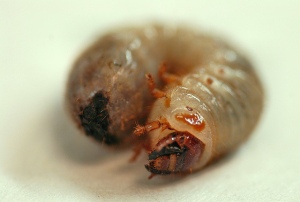
The beetle as a grub. Not so pretty now are they? (Photo by Rob Swatski via flickr)
Supposedly the larvae is edible, very rich in protein and a favorite treat for the packs of raccoons that frequent the urban setting of Highland Park. But rather than eating them, I remember them best as those little creatures we liked to enslave for our amusement as kids:
The Next Twelve Years?

The post-election pile.
The results have been certified. The people have spoken. Another member from the California Legislature has been sworn into the Los Angeles City Council. 10,152 residents of Council District 1 voted for Gil Cedillo and 9,389 voted for Jose Gardea, giving Cedillo a victory by 763 votes. For all intents and purposes this could mean the next twelve years will likely be spent with Gil Cedillo as Councilmember for CD1 until he is forced-out by law after three terms.
Now our City Council with the most lucrative salary of any municipality in the United States ($178,790 annually) is nearly half-filled with professional politicians who were forced-out of the state legislature by term limits, with more certainly on their way in the coming years. This unintended consequence of term limits is explored by David Zahniser in a recent article in the Los Angeles Times. The fear is that a council filled with old-pros instead a diverse pool of local faces could hinder the democratic process. That a Council obedient to the charming yet iron fist of former Assembly speaker, now Council President, Herb Wesson will not serve the people who elected them. This growing lack of diversity in City Council could be found on July 3rd when a council comprised ENTIRELY of men came to order in Council Chambers. (First time since 1969.)

Gil Cedillo at the City Inauguration.
The good news is that Gil Cedillo is a capable leader with many political friends in labor and in the California Democratic Party. How will that will be applied to Council District 1 is unknown. What is known is that Highland Park will be getting more attention by mere proximity with the addition of his district office on the corner of Figueroa and Avenue 56. So that’s a plus. Maybe he will be successful in fulfilling Reyes’ promise to make the long-vacant Security Pacific Building across the avenue into a Northeast Los Angeles City Hall. There is a lot for Cedillo to learn about local issues, luckily for him, an opportunity to educate our new councilman will take place this Tuesday, July 30th from 7pm to 8pm at Ramona Hall (4580 N. Figueroa St) Mt. Washington Elementary School (3981 San Rafael Ave). We will have just an hour to express our concerns for CD 1 at what he is calling “Mt. Washington Town Hall.” See Patch for more.
Now if we can just get Gil to understand and respect what Historic Preservation Overlay Zones (HPOZ) and Los Angeles Historic Cultural Monument (LAHCM) status means…

The Highland Park Masonic Temple Building with historic windows from 1923.

The Highland Park Masonic Temple Building with historic 1923 widows removed for Cedillo’s new district field office.


 90042
90042 